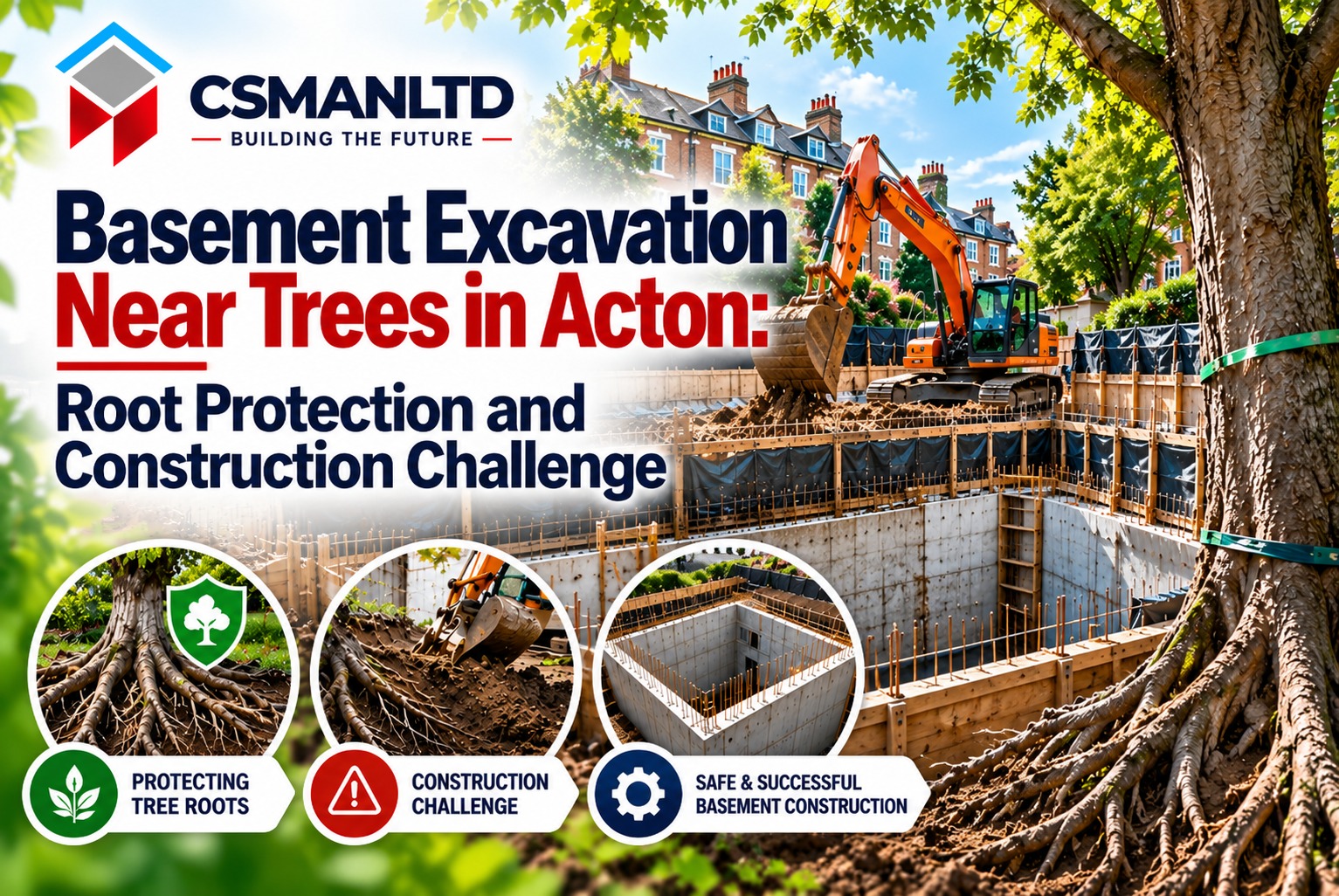
Basement excavation near established trees requires close coordination between the arboricultural consultant, structural engineer and construction team. The challenge is translating tree protection requirements into a workable excavation plan without compromising the engineered basement design.
For homeowners considering Basement Construction in Acton, the key issue is how root protection information influences the basement footprint, temporary works and day to day site operations.
Reading Root Protection Drawings Before Excavation
BS 5837:2012, Trees in relation to design, demolition and construction, provides guidance on assessing trees and protecting them during development. An arboricultural survey may identify relevant trees, their root protection areas (RPAs) and the constraints these create for proposed building work.
The RPA is generally represented on a plan as an area around a tree intended to protect roots and the soil that supports them. It is not a direct map of every root, nor should it be interpreted as automatic permission to excavate outside the marked boundary.
Before construction planning is finalised, the team should overlay the arboricultural drawings with the proposed basement layout. This helps identify conflicts involving retaining walls, excavation limits, access routes and temporary support installations. Any proposed work that could affect the RPA needs appropriate professional assessment rather than an assumption that the original layout can proceed unchanged.
When the Basement Footprint Conflicts With Tree Protection
A basement may fit within the available garden dimensions but still create difficulties when its excavation boundary overlaps a protected rooting area. The conflict can involve more than the permanent basement wall. Temporary excavation support, working space and the equipment needed to install structural elements may also affect the area available for construction.
The design team can investigate whether the footprint, wall arrangement or construction method can be modified. However, moving a wall is not automatically the best solution because it may affect structural calculations, internal space or other site constraints.
Where a proposed change is considered, the arboricultural and structural implications should be reviewed together. The aim is to agree a buildable arrangement before site operations begin, rather than discovering that the planned method cannot be followed once the ground has been opened.
Managing Machinery and Materials Around Protected Areas
Tree protection can be undermined by site activities even when excavation itself stays within the planned boundary. Heavy machinery, stored materials, repeated vehicle movements and changes to ground levels can damage soil structure or affect protected roots.
A practical site plan should identify where excavation equipment can operate, where spoil can be temporarily held and how materials will reach the working area. The agreed tree protection measures must remain effective throughout the relevant construction stages.
Restricted access can make this coordination particularly important. If machinery cannot reach the excavation without crossing a protected area, the contractor and design team may need to consider a different access arrangement or construction sequence. The selected approach should be compatible with both the engineering design and the arboricultural recommendations.
What Happens When Excavation Reveals Roots?
Roots uncovered during digging may differ from what the project team expected from the initial drawings. Their presence can affect the planned excavation line or interfere with work in a particular section.
Operatives should not cut, remove or relocate an exposed root simply to maintain progress. The appropriate response is to stop the affected activity, protect the exposed area where practicable and refer the issue to the relevant arboricultural consultant and design team.
Their assessment can establish whether the excavation method or sequence needs to change. Any agreed adjustment should be communicated to the site team so that subsequent work follows the revised instructions. This avoids informal decisions being made at the excavation face without considering their wider consequences.
Coordinating Tree Protection With Temporary Works
Temporary works need particular attention because they may occupy space beyond the finished basement structure. Depending on the engineered solution, excavation support and installation activities could create constraints near a tree protection area.
The construction sequence should therefore be reviewed against both the permanent design and the temporary works arrangements. The team needs to understand where support will be installed, how the excavation will progress and whether the planned operations are compatible with the agreed tree protection measures.
If a conflict emerges, it should be resolved through the responsible designers before the affected work proceeds. Changing the sequence on site without reviewing the engineering implications could introduce risks that were not considered in the original plan.
Planning Tree Sensitive Basement Construction in Acton
Every site presents a different combination of tree locations, available access and structural requirements. An effective approach starts with coordinated drawings, clear site instructions and an agreed process for dealing with unexpected conditions.
For Basement Construction in Acton, CSMANLTD can take construction access, excavation arrangements and structural sequencing into account when developing the build approach. Arboricultural assessments and engineering decisions should be provided by the appropriately qualified professionals responsible for those aspects of the project.
Addressing tree protection before excavation begins helps the construction team identify practical constraints early, reduce avoidable disruption and work towards a basement design that can be built in accordance with the agreed requirements.