
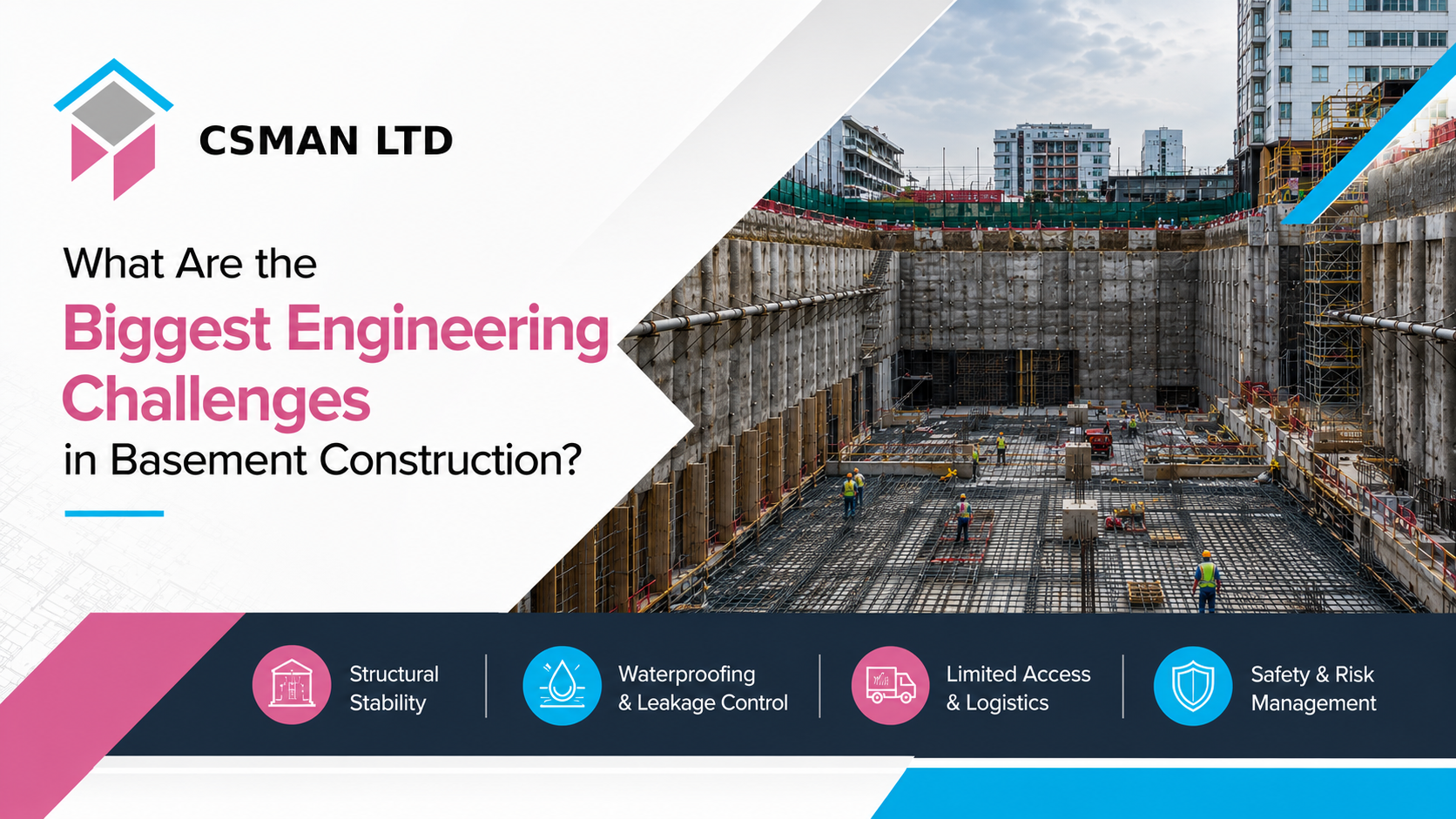
Deep basement construction can create valuable additional space beneath a property, but achieving a successful result involves far more than excavation and concrete installation. Every basement project requires detailed planning, engineering expertise, and careful coordination to ensure the structure performs safely and efficiently over the long term.
Whether developing a basement beneath an existing property or constructing a new underground level, engineers must balance structural integrity, environmental conditions, buildability, and long-term performance.
Below are some of the most significant engineering challenges encountered during basement construction and the practical solutions used to overcome them.
1. Understanding Ground Conditions and Site Behaviour
Every basement project begins below the surface, making ground investigation one of the most important stages of the process.
No two sites behave exactly the same. Soil composition, underground water conditions, previous development history, and geological variations can significantly influence how excavation and structural design should be approached.
A site with stable soil may allow straightforward excavation, while another location may require extensive support and ground improvement measures.
Common considerations include:
- Soil type and composition
- Groundwater levels
- Existing underground conditions
- Bearing capacity
- Historical site development
Without detailed investigation, hidden conditions can lead to delays, redesign, and increased construction complexity.
Engineering Approach
Engineers typically perform comprehensive site assessments before construction begins. This information allows teams to develop excavation strategies and structural systems suited to actual ground conditions rather than assumptions.
2. Maintaining Structural Stability During Excavation
One of the most technically demanding aspects of basement construction is maintaining stability while removing large volumes of soil.
Excavation changes the natural balance of forces acting around a structure. If these forces are not properly managed, movement can occur within the building itself or neighbouring properties.
This challenge becomes more significant in urban environments where buildings are closely positioned.
Potential concerns include:
- Foundation movement
- Ground settlement
- Structural cracking
- Changes in load distribution
- Lateral soil pressure
Engineering Approach
Structural engineers develop staged excavation plans supported by temporary and permanent structural systems that allow construction to progress while maintaining stability.
Monitoring throughout construction helps identify movement early and enables adjustments where necessary.
3. Managing Groundwater and Waterproofing Performance
Water is often one of the most difficult elements to control in basement construction.
Underground structures are exposed to varying groundwater conditions and hydrostatic pressure. If water management is not properly considered during design and construction, long-term usability may be affected.
Challenges commonly include:
- Water ingress
- Moisture penetration
- Hydrostatic pressure build-up
- Condensation risk
- Drainage limitations
Waterproofing is not simply a finishing detail. It is a core engineering component of the basement structure.
Engineering Approach
Effective basement construction combines structural protection with long-term moisture management strategies.
Modern projects often integrate:
- Waterproof structural systems
- Drainage planning
- Controlled water management
- Maintenance access considerations
A properly designed waterproofing strategy supports long-term durability and occupant comfort.
4. Excavation Constraints in Urban Environments
Basement construction becomes increasingly complex when working within dense urban areas.
Limited site access often affects equipment selection, excavation sequencing, material deliveries, and waste removal.
Urban projects may also require careful coordination to minimise disruption.
Challenges can include:
- Restricted access points
- Limited working areas
- Material handling limitations
- Neighbouring property protection
- Construction sequencing constraints
Engineering Approach
Successful projects rely on detailed logistics planning and carefully phased construction processes that improve efficiency while maintaining safety.
5. Retaining Surrounding Ground During Construction
Excavation creates pressure changes that can affect surrounding soil and nearby structures.
Temporary and permanent retaining systems are often required to hold surrounding ground safely during construction.
Key engineering concerns include:
- Soil movement
- Excavation stability
- Earth pressure
- Ground displacement
Engineering Approach
Retaining systems are designed specifically for site conditions and integrated into the overall structural strategy to maintain excavation safety and long-term performance.
6. Supporting Existing Buildings Through Underpinning
Many basement developments are completed beneath occupied or existing structures.
Where existing foundations do not extend deep enough to support excavation, additional support methods may be required.
Underpinning presents several engineering challenges:
- Maintaining structural stability
- Managing settlement risk
- Supporting changing load paths
- Protecting existing finishes and structures
Engineering Approach
Construction teams typically implement carefully sequenced support methods that maintain stability throughout excavation and structural works.
The process requires close coordination between engineers and site teams.
7. Ventilation, Comfort, and Long-Term Usability
A successful basement should not only be structurally sound—it should also function as a comfortable and practical environment.
Because deep basements receive limited natural airflow and daylight, environmental planning becomes essential.
Key considerations include:
- Air circulation
- Humidity control
- Thermal performance
- Internal comfort
- Long-term energy efficiency
Engineering Approach
Mechanical systems and environmental controls are integrated early in the design process to create healthy, usable underground spaces.
8. Construction Safety and Risk Management
Basement construction involves working below ground level in constantly changing site conditions.
Maintaining safe operations requires proactive planning throughout the project lifecycle.
Typical focus areas include:
- Excavation safety
- Structural inspections
- Monitoring procedures
- Emergency planning
- Site coordination
Safety management not only protects workers but also supports smoother project delivery.
Frequently Asked Questions About Deep Basement Construction
After understanding the engineering challenges involved in basement construction, many property owners still have practical questions before starting a project. Below are answers to some of the most common concerns.
How Deep Can a Basement Be Constructed?
There is no single standard depth for basement construction because every project depends on factors such as site conditions, structural requirements, surrounding buildings, and local planning controls.
The final depth is typically determined after assessing:
- Ground conditions
- Existing foundations
- Groundwater levels
- Intended basement use
- Structural design requirements
A detailed engineering assessment helps establish what is technically achievable and appropriate for the property.
Why Is Ground Investigation So Important Before Basement Construction?
Ground investigation helps engineers understand what exists beneath the site before excavation begins.
Without proper investigation, projects may encounter:
- Unexpected soil conditions
- Underground obstructions
- Water-related complications
- Additional structural requirements
Early analysis improves planning accuracy and reduces construction uncertainty.
What Makes Waterproofing One of the Most Important Parts of Basement Construction?
Because basements are constructed below ground level, they remain exposed to moisture and groundwater pressure throughout their lifespan.
A strong waterproofing strategy helps:
- Reduce water ingress risk
- Improve long-term durability
- Protect interior finishes
- Maintain comfortable internal conditions
Waterproofing should always be considered during the design stage rather than after construction begins.
Can Basement Construction Be Completed Under an Existing Property?
Yes. Many basement developments are successfully constructed beneath existing buildings.
However, these projects usually require:
- Structural assessments
- Excavation planning
- Temporary support measures
- Foundation strengthening where necessary
Construction sequencing becomes especially important to maintain stability.
Will Basement Construction Affect Nearby Buildings?
Construction activity can influence surrounding ground conditions if not properly managed.
To minimise impact, engineering teams often implement:
- Ground movement monitoring
- Structural inspections
- Excavation controls
- Retaining systems
- Continuous site observation
Careful planning helps reduce risks to neighbouring properties.
How Long Does Deep Basement Construction Usually Take?
Construction timelines vary depending on project complexity.
Factors that commonly influence programme duration include:
- Basement size and depth
- Site accessibility
- Ground conditions
- Structural requirements
- Waterproofing systems
- Interior completion works
A phased construction approach generally supports more efficient delivery.
Is Basement Construction a Good Long-Term Investment?
Additional underground space can improve property functionality and provide flexibility for future use.
Deep basements are commonly developed into:
- Living areas
- Entertainment spaces
- Home offices
- Wellness rooms
- Utility and storage areas
Long-term value depends on design quality, construction standards, and usability.
What Is the Biggest Engineering Challenge in Deep Basement Construction?
Although every project is different, the most common engineering challenges usually involve balancing:
- Ground stability
- Structural support
- Water management
- Excavation sequencing
- Long-term performance
Successful basement construction depends on treating these elements as connected parts of a complete engineering solution.
What Should Property Owners Consider Before Starting Basement Construction?
Before beginning a project, it is helpful to evaluate:
- Project goals
- Site conditions
- Structural feasibility
- Waterproofing strategy
- Construction access
- Budget expectations
- Long-term maintenance considerations
Early planning often leads to smoother project delivery and better outcomes.
Areas We Serve Across London
We provide basement construction services across Kensington, Belgravia, Brompton, Chelsea, Croydon, Dartford, Epsom, Fulham, Greenwich, Hammersmith, Harrow, Hayes, Maida Vale, Marylebone, Notting Hill, Pimlico, Richmond, Stratford, Twickenham, Wandsworth and Westminster.
For every project, the focus remains the samecareful engineering, practical construction methods, and creating underground spaces designed for long-term performance.
Bringing Engineering and Practical Construction Together
Deep basement construction requires more than technical expertise. it requires coordinated decision-making across design, engineering, construction, and long-term building performance.
The most successful projects combine detailed planning, robust structural solutions, effective waterproofing, and disciplined construction management.
At CSMAN LTD, basement construction London is approached with a focus on engineering accuracy, practical buildability, and creating underground spaces that remain safe, functional, and durable for years to come.