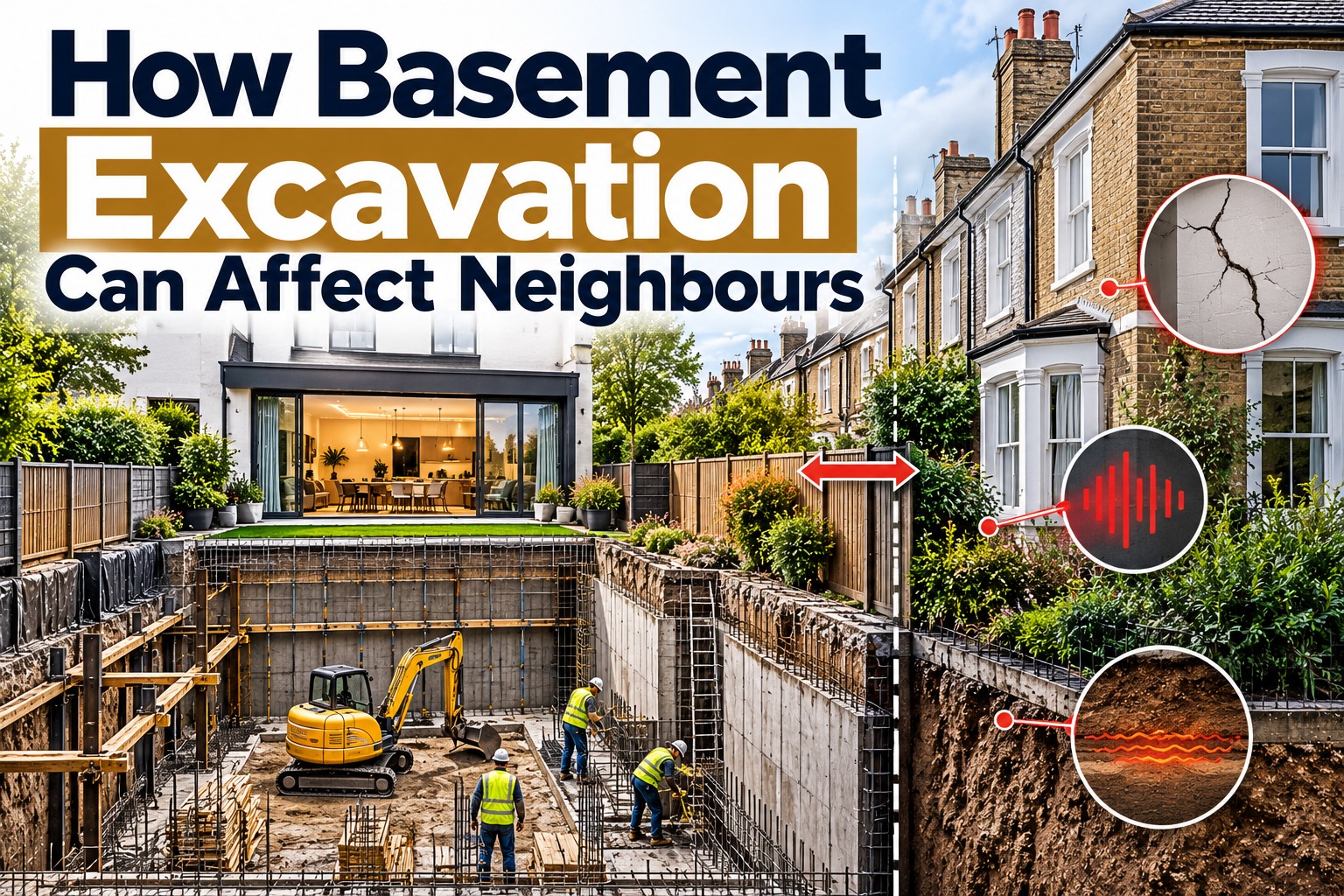
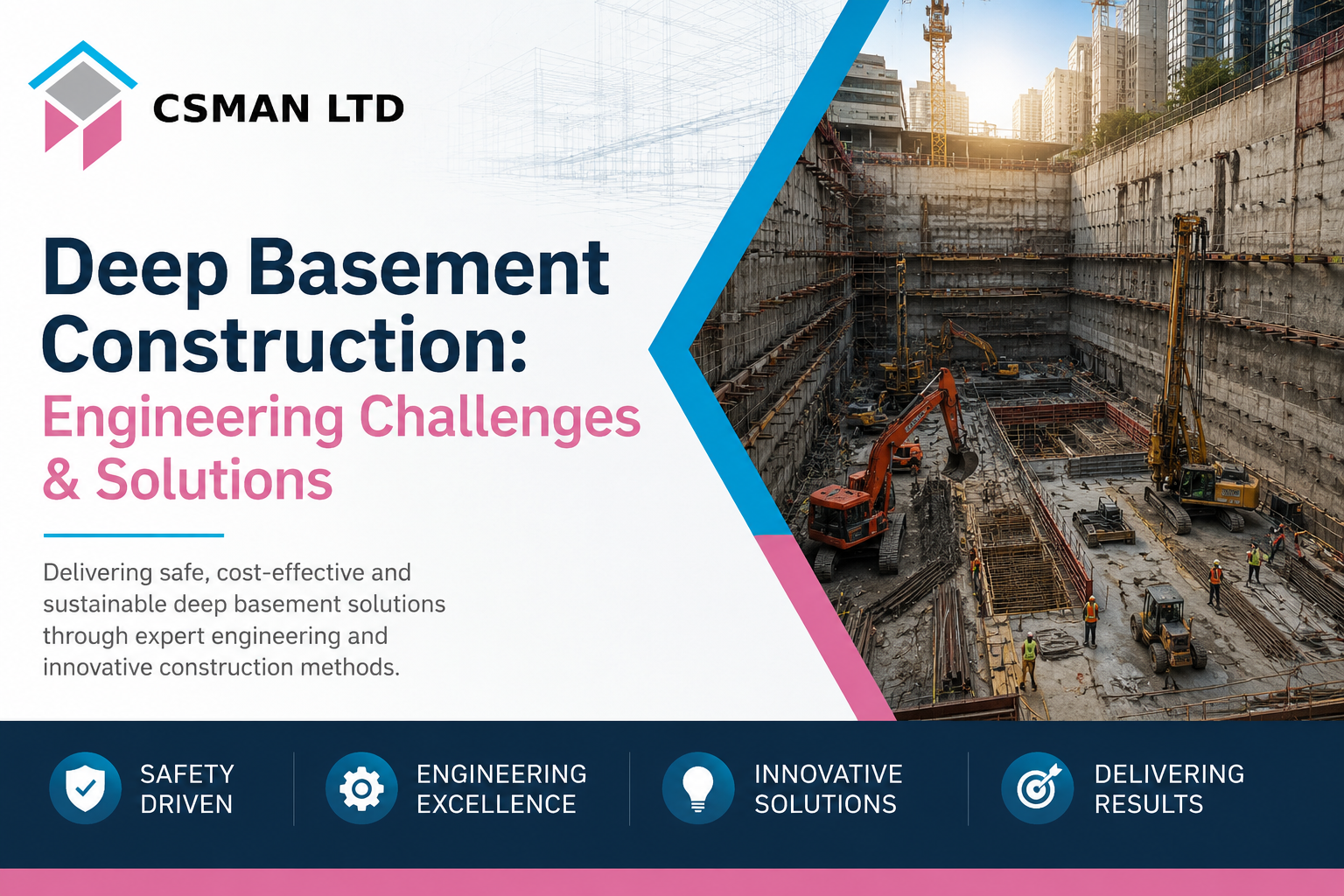
As cities continue to grow and available land becomes increasingly limited, property owners and developers are looking below ground to create additional usable space. Deep basement construction has become one of the most effective ways to expand buildings while preserving external footprints and maximizing property potential.
Particularly in basement construction in London, deep basements have become increasingly popular for creating luxury living areas, parking, entertainment spaces, wellness facilities, utility rooms, and flexible underground environments.
However, building below ground level involves far more than excavation. Deep basement projects require advanced structural engineering, geotechnical analysis, groundwater control, and precise construction methods to ensure long-term safety and performance.
This guide explores the engineering challenges involved in deep basement construction and the practical solutions used to deliver successful underground developments.
Understanding Deep Basement Construction
Deep basement construction involves creating one or multiple underground levels beneath an existing or new structure. These projects often extend significantly below traditional foundation depths and require specialist engineering to maintain structural integrity.
Deep basements are commonly developed for:
- Additional residential living space
- Underground garages
- Home cinemas and entertainment areas
- Indoor wellness facilities and gyms
- Commercial storage areas
- Utility and plant rooms
- Multi-purpose underground environments
In urban developments, basement construction in London allows owners to gain additional space without sacrificing outdoor areas or altering the building’s appearance.
Why Deep Basement Construction Is Increasing
The growing demand for underground development is driven by several practical and economic factors.
Limited Development Space
Urban locations often offer little room for outward expansion, making underground construction an attractive alternative.
Rising Property Values
Creating additional usable square footage can significantly improve property functionality and market value.
Modern Space Requirements
Homeowners increasingly require dedicated spaces for remote work, wellness, entertainment, and storage.
Planning and Design Flexibility
Underground development can sometimes provide more flexibility than visible extensions in constrained urban environments.
Major Engineering Challenges in Deep Basement Construction
Constructing deep basements introduces technical and environmental complexities that require careful planning.
Ground Investigation and Site Analysis
Every successful basement project begins with understanding the conditions beneath the site.
Engineers typically assess:
- Soil composition
- Groundwater levels
- Existing foundations
- Geological characteristics
- Load-bearing capacity
Engineering Challenges
- Unpredictable soil conditions
- Variable ground strength
- Underground obstructions
- Settlement risk
Engineering Solutions
- Detailed geotechnical surveys
- Borehole investigations
- Ground monitoring systems
- Soil stabilization techniques
Early site analysis reduces construction risk and improves decision-making.
Structural Stability During Excavation
Excavation changes the natural balance of soil pressure surrounding a building.
Without proper support, nearby structures may experience movement.
Engineering Challenges
- Ground displacement
- Foundation movement
- Structural settlement
- Increased lateral pressure
Engineering Solutions
- Temporary structural supports
- Retaining systems
- Sequential excavation methods
- Reinforced structural design
Continuous monitoring helps maintain stability throughout construction.
- Groundwater and Waterproofing Management
Water remains one of the most significant challenges in deep basement projects.
Excavation below groundwater level introduces pressure that must be carefully controlled.
Engineering Challenges
- Water ingress
- Hydrostatic pressure
- Moisture penetration
- Flooding during construction
Engineering Solutions
- Basement waterproof membranes
- Drainage systems
- Groundwater control measures
- Sump and pump systems
Long-term waterproofing planning is essential for basement durability.
- Retaining Wall Design and Earth Pressure Control
Retaining systems prevent surrounding soil from collapsing into excavation areas.
Engineering Challenges
- Soil movement
- High earth loads
- Water pressure build-up
- Long excavation durations
Engineering Solutions
Common retaining systems include:
- Reinforced concrete walls
- Secant pile walls
- Sheet piling systems
- Diaphragm wall construction
The appropriate solution depends on soil and project requirements.
- Underpinning Existing Structures
Many basement developments occur beneath occupied buildings.
Existing foundations often require temporary or permanent reinforcement.
Engineering Challenges
- Maintaining structural stability
- Preventing settlement
- Supporting existing loads
Engineering Solutions
Engineers may use:
- Mass concrete underpinning
- Beam and base systems
- Mini-pile solutions
- Sequential underpinning methods
Careful sequencing minimizes movement risk.
- Excavation Constraints in Urban Areas
Dense urban environments create additional logistical challenges.
Engineering Challenges
- Restricted access
- Limited storage areas
- Equipment movement limitations
- Neighbouring property protection
Engineering Solutions
- Phased construction programs
- Compact excavation equipment
- Material management planning
- Controlled excavation schedules
Effective site planning improves efficiency and reduces disruption.
- Ventilation and Environmental Performance
Underground environments require carefully designed internal systems.
Engineering Challenges
- Limited airflow
- Temperature control
- Humidity management
Engineering Solutions
- Mechanical ventilation systems
- Air circulation planning
- Energy-efficient climate control
- Moisture management systems
Proper environmental design improves comfort and usability.
Modern Technologies Improving Deep Basement Construction
Construction technology continues improving basement performance and project outcomes.
Building Information Modelling (BIM)
Supports planning accuracy and project coordination.
3D Ground Modelling
Improves excavation and structural prediction.
Structural Monitoring Systems
Tracks settlement and building movement in real time.
Advanced Waterproofing Materials
Enhances long-term protection against moisture.
These technologies help reduce construction uncertainty and improve project quality.
Safety Considerations in Deep Basement Projects
Safety planning remains critical throughout construction.
Essential measures include:
- Excavation risk assessments
- Structural inspections
- Ground movement monitoring
- Emergency procedures
- Workforce safety training
Proactive safety management supports successful project delivery.
Best Practices for Successful Basement Construction
For long-term success, basement projects should focus on:
- Detailed site investigations
- Comprehensive structural design
- High-quality waterproofing systems
- Continuous monitoring
- Efficient construction sequencing
- Long-term maintenance planning
A structured approach improves performance and minimizes future issues.
Frequently Asked Questions
How deep can basement construction go?
Depth depends on structural design, soil conditions, groundwater levels, and local planning requirements.
Is basement construction suitable for existing homes?
Yes. Many projects successfully create new underground space beneath existing properties through specialist excavation and underpinning techniques.
How important is waterproofing in basement construction?
Waterproofing is one of the most critical aspects of basement performance and directly affects durability and usability.
Does basement construction increase property value?
Additional functional space may improve property usability and contribute to long-term value.
What is the biggest engineering challenge in deep basement construction?
Ground stability and groundwater management are typically among the most complex aspects of underground development.
Areas We Serve Across London
We primarily deliver basement construction solutions across:
Kensington,
Belgravia,
Brompton,
Chelsea,
Croydon,
Dartford,
Epsom,
Fulham,
Greenwich,
Hammersmith,
Harrow,
Hayes,
Maida Vale,
Marylebone,
Notting Hill,
Pimlico,
Richmond,
Stratford,
Twickenham,
Wandsworth and
Westminster.
Deep basement construction requires specialist engineering, careful execution, and long-term planning to create safe and valuable underground spaces.